

The Conservative’s Burden: Rebuilding a Philosophy from the Ashes of Its Imitations
Part 1: What is Conservatism

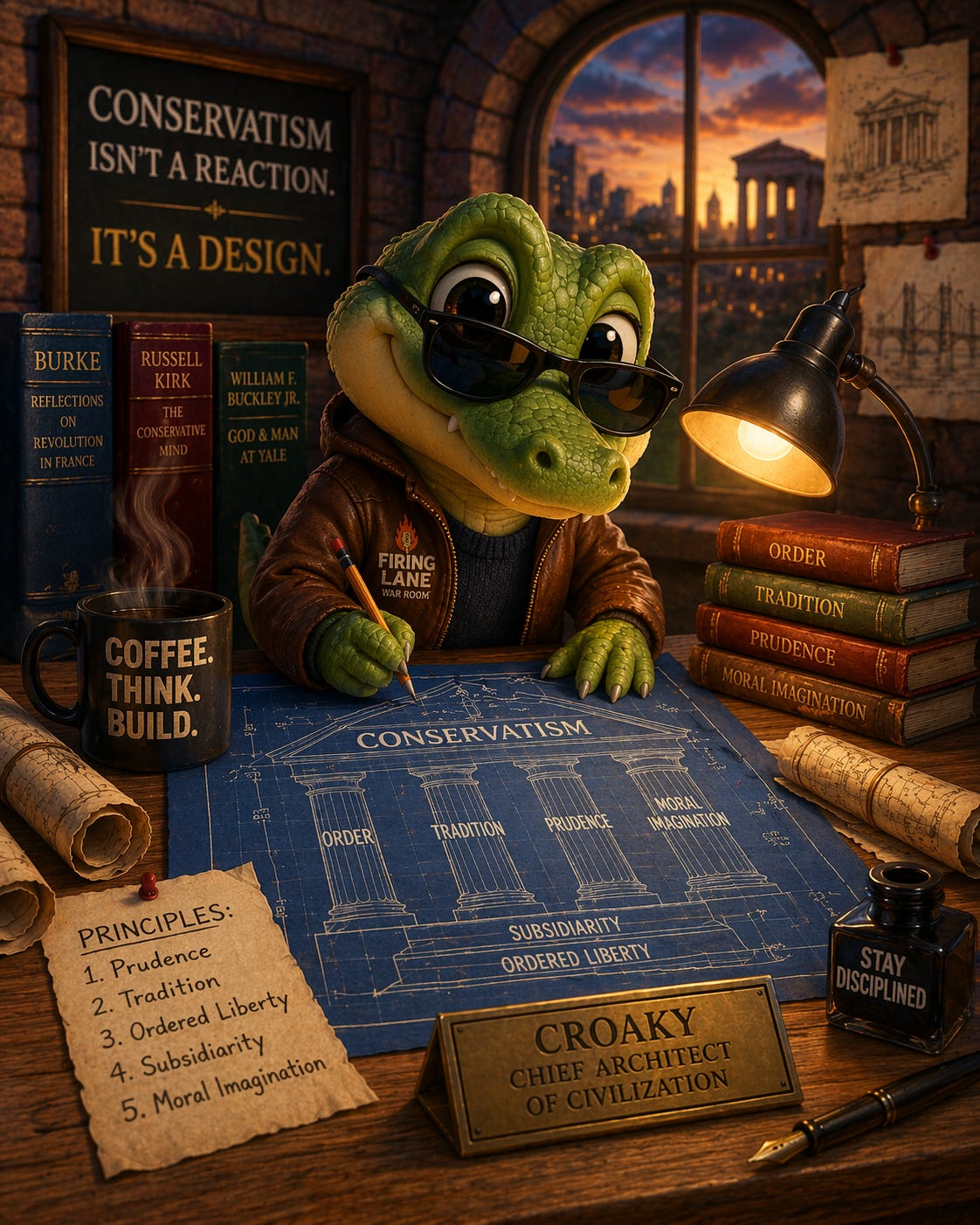
🐊 Croaky Caiman
☕ Buy Me a Coffee 📻 Firing Lane Podcast | 💬 Substack |
👗 Mrs. Croaky’s Merch Shop | Twitter @RationalPurview
There was a time, it’s not so distant that it escapes memory, but distant enough that it escapes practice—when conservatism was not a costume worn for applause, or a cudgel swung in the direction of your preferred enemies. It was, instead, a discipline. A way of seeing. A commitment to continuity in a world addicted to rupture.
Today, we are told that conservatism is “winning.” One is tempted to ask: winning what, precisely? The right to abandon its own intellectual inheritance in favor of whatever slogan polls best this week?
Let me do what I usually do and provide something unfashionable.
Let me define the thing, that many who call themselves conservative never can really define since it’s a buzzword for many.
I. What Conservatism Is
Contrary to your average influencer Conservatism doesn’t begin with outrage but with inheritance.
It’s the recognition—articulated most clearly by my boy Edmund Burke—that society is not an improvisation but an accumulation. A loooong, imperfect, often contradictory accumulation of customs, institutions, and moral insights that have survived not because they’re flawless, but because they’re functional.
It is, therefore, an orientation grounded in several core principles:
1. Prudence over impulse
Policy isn’t judged by its intentions, but by its consequences—particularly its unintended ones. The conservative asks not “Is this good?” but “What happens next?”
2. Tradition as distributed knowledge
Customs aren’t arbitrary relics; they’re solutions to problems we have often forgotten how to articulate. To discard them lightly is to assume one’s own superiority to centuries of lived experience—a presumption rarely justified.
3. Ordered liberty
Freedom is not the absence of restraint but the presence of structure. Liberty without order dissolves into chaos; order without liberty calcifies into tyranny. Conservatism insists on the tension—and the balance.
4. Moral imagination
A term later refined by Russell Kirk, this is the ability to see society not as an abstraction, but as a living tapestry of human relationships—binding the dead, the living, and the unborn.
5. Incrementalism
Change is not rejected—but it is disciplined. Reform, yes. Revolution, no. The conservative improves what exists rather than gambling on what might.
In short:
Conservatism is the philosophy of continuity under constraint.
Tomorrow I’ll go into number II on my Buy Me a Coffee.:
II. What Conservatism Is Not....
Follow on Twitter @RationalPurview
Croaky Caiman is Founder of The Rational Purview.
If you believe in conserving intelligence before ideology, consider becoming a paid subscriber. Someone has to keep the gators reading Burke.🎙 Listen to Firing Lane.
☕ Support the anti-grift with a donation to Buy Me a Coffee.
🛍 Check out @MrsCroaky’s merch store.
Follow on Twitter @RationalPurviewThe fight for reason isn’t won in a day. But we can win it one argument at a time.
[🔔 Subscribe to The Rational Purview | 💰 Buy Me a Coffee | 🐊 Croaky Merch Shop]